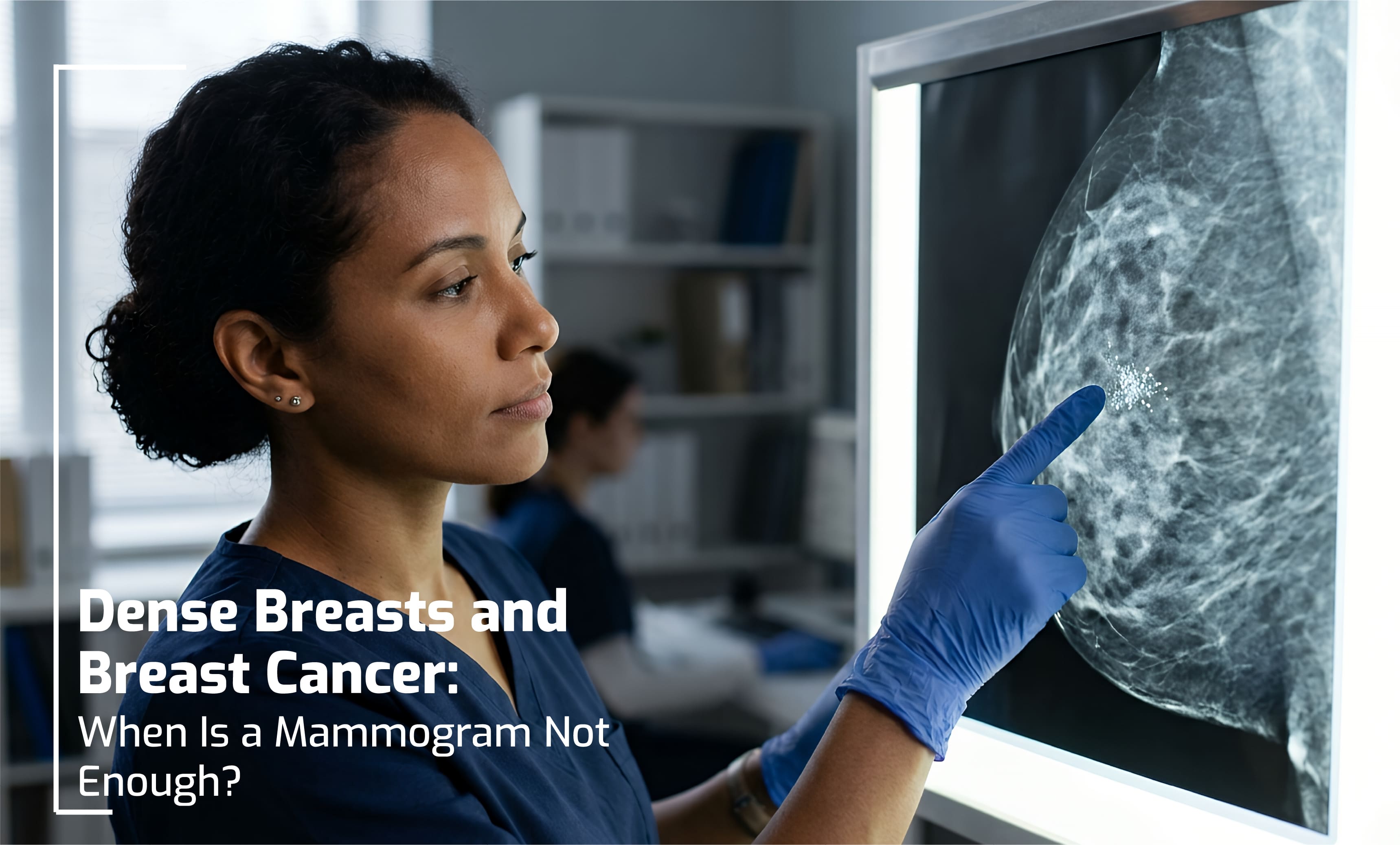
Dense Breasts and Breast Cancer: When Is a Mammogram Not Enough? | Dr. Sanjay Sharma
A mammogram is one of the most important tools for detecting breast cancer early. But what happens when your mammogram report says that you have dense breasts?
For many women, the word “dense” can be confusing or worrying. You may have a mammogram that says there is no evidence of cancer, yet the report also mentions that your breasts are “heterogeneously dense” or “extremely dense.” This can raise an important question: Is a normal mammogram enough when you have dense breast tissue?
The answer is not always straightforward.
Dense breast tissue is common and is not a disease. However, it can make certain breast cancers more difficult to see on a mammogram. Dense breast tissue can also be associated with a higher risk of developing breast cancer compared with less-dense breast tissue. This means that breast density can affect both breast cancer risk and the ability of mammography to detect a cancer.
For some women, mammography alone may be appropriate. For others, particularly those with additional risk factors or concerning symptoms, a doctor may recommend additional breast imaging or a different diagnostic approach.
If you have recently received a mammogram report mentioning dense breasts, understanding what it means is the first step toward making an informed decision about your breast health.
What Are Dense Breasts?
Breasts contain a combination of fatty tissue, glandular tissue and fibrous connective tissue. Breast density refers to how much fibrous and glandular tissue appears compared with fatty tissue on a mammogram.
Radiologists generally classify breast density into four categories:
- Almost entirely fatty
- Scattered areas of fibroglandular density
- Heterogeneously dense
- Extremely dense
The last two categories heterogeneously dense and extremely dense breasts are considered dense breasts.
Importantly, breast density cannot be determined reliably by simply touching or examining the breasts. It is a characteristic seen on mammography and is reported by the radiologist.
Breast density is also not necessarily permanent. It can change with age, hormonal factors and other circumstances.
So, if your mammogram says you have dense breasts, it does not mean that something is wrong with your breasts. It means that your breast tissue has a higher proportion of fibrous and glandular tissue.
Why Do Dense Breasts Matter for Breast Cancer Screening?
There are two separate reasons why breast density matters.
First, dense breast tissue is associated with an increased risk of breast cancer.
Second, dense tissue can make a mammogram more difficult to interpret.
On a mammogram, fatty tissue generally appears dark, while dense fibroglandular tissue appears white. Many abnormalities, including some breast cancers, can also appear white. When a breast contains a large amount of dense tissue, an abnormality may therefore be harder to distinguish from the surrounding tissue.
This is sometimes described as a “masking effect.”
It does not mean that mammograms are useless for women with dense breasts. Mammography remains an important breast cancer screening tool. However, its sensitivity can be lower in women with dense breast tissue.
That is why a normal mammogram does not always answer every breast-health question.
Does Having Dense Breasts Mean You Have Breast Cancer?
No.
Having dense breasts does not mean you have breast cancer.
It also does not mean that you will definitely develop breast cancer in the future.
Dense breast tissue is a common characteristic, and many women with dense breasts never develop breast cancer. However, breast density is one of several factors that can influence breast cancer risk.
Your overall risk depends on a combination of factors, including your age, family history, genetic risk, previous breast conditions, reproductive history and other individual factors.
Therefore, breast density should ideally be considered as part of your overall breast cancer risk assessment, rather than viewed in isolation.
When Is a Mammogram Not Enough?
A mammogram may not be enough when there is a clinical reason to investigate something further.
For example, additional evaluation may be appropriate when:
- You have a new breast lump despite a normal mammogram.
- You notice a persistent change in the breast.
- There is nipple discharge, particularly bloody or spontaneous discharge.
- There is a new change in the nipple or skin.
- You have a strong family history of breast cancer.
- You have a known genetic mutation associated with increased breast cancer risk.
- You have previously had breast cancer.
- Your mammogram shows an abnormal or incomplete finding.
- Your doctor believes your overall risk is higher than average.
- Your breast density makes interpretation particularly challenging.
The important point is that a normal mammogram should not automatically end the evaluation of a persistent breast symptom.
If something feels different or concerning, discuss it with a breast specialist even if your mammogram is reported as normal.
Dense Breasts and a Normal Mammogram: Can Cancer Still Be Present?.
Yes, it is possible.
A normal mammogram means that the radiologist did not identify a suspicious abnormality on that examination. It does not provide an absolute guarantee that breast cancer is absent.
This is particularly relevant in dense breasts because dense tissue can make some abnormalities harder to see. The American College of Radiology notes that extremely dense breast tissue lowers the sensitivity of mammography.
This is one reason doctors sometimes consider additional imaging based on a woman's breast density, symptoms and overall risk
However, this does not mean every woman with dense breasts needs multiple tests every year. More imaging can also lead to additional recalls, benign findings and unnecessary biopsies.
The goal is not to order every available test.
The goal is to choose the right test for the right woman at the right time.
What Can Be Done When Mammography Is Limited by Dense Breast Tissue?
Depending on your individual situation, a doctor may consider additional breast imaging.
1. Breast Ultrasound: Breast ultrasound uses sound waves to create images of breast tissue.It can be particularly useful when evaluating a specific lump or area of concern. Ultrasound can sometimes identify abnormalities that are difficult to distinguish on a mammogram, especially in dense breast tissue. Studies have found that supplemental ultrasound can detect some mammographic ally occult cancers in women with dense breasts. However, it can also increase call-backs, false-positive results and benign biopsies. Therefore, ultrasound is not automatically required simply because a mammogram reports dense breasts.It may be particularly useful when there is a specific clinical concern, such as a palpable lump, or when a doctor believes additional screening is appropriate.
2. Breast MRI: Breast MRI provides highly detailed images of the breast and can detect cancers that may not be visible on mammography. MRI is particularly important in women who have a sufficiently high overall risk of breast cancer. It may also be considered in some women with dense breasts depending on their risk profile and other factors. MRI is more sensitive than mammography, but it can also detect findings that are ultimately benign. It may therefore result in additional imaging or biopsies. Current evidence and recommendations differ depending on a woman's risk level and breast density. For example, the ACR considers breast MRI potentially appropriate as supplemental screening in some women with heterogeneously dense breasts and considers supplemental MRI in certain dense-breast situations based on risk. The decision should therefore be individualized rather than based solely on the word “dense” in a mammogram report.
3. Digital Breast Tomosynthesis: Digital breast tomosynthesis, sometimes called 3D mammography, takes multiple images of the breast from different angles and reconstructs them into a series of thin images. This can help reduce the problem of overlapping breast tissue and may improve cancer detection compared with conventional digital mammography in some women with dense breasts. For this reason, 3D mammography may be considered as part of breast cancer screening depending on age, risk and availability.
Does Every Woman With Dense Breasts Need an Ultrasound or MRI?
No.
This is one of the most important things to understand about dense breasts.
There is no universal rule that every woman with dense breasts must undergo an ultrasound or breast MRI after every normal mammogram.
Different medical organizations and guidelines consider factors such as breast density, age, family history and overall breast cancer risk when discussing supplemental screening. The USPSTF has stated that evidence is currently insufficient to recommend for or against supplemental ultrasound or MRI solely for women with dense breasts.
At the same time, the American College of Radiology recognizes that supplemental screening may be appropriate for certain women with dense breasts depending on their individual circumstances.
This is why an individualized consultation matters.
Instead of asking only, “Are my breasts dense?” a better question is:
“What is my overall breast cancer risk, and is my current screening strategy appropriate for me?”
What If You Have Dense Breasts Plus a Family History of Breast Cancer?
Dense breasts become more important when combined with other risk factors.
For example, suppose your mother or sister had breast cancer at a relatively young age. You may have dense breasts and a significant family history. Your screening needs may be different from those of another woman of the same age who has dense breasts but no additional risk factors.
Other factors that may influence risk include:
- A strong family history of breast or ovarian cancer
- Certain inherited genetic mutations
- Previous breast cancer
- Certain previous high-risk breast lesions
- Previous chest radiation at a young age
- Other factors included in formal breast cancer risk assessment
In these situations, your doctor may recommend a more personalized screening strategy.
For women at sufficiently high risk, breast MRI may be recommended in addition to mammography.
What If You Feel a Lump but Your Mammogram Is Normal?
This is an important situation that should not be ignored.
If you can feel a persistent lump but your mammogram is reported as normal, speak with a doctor rather than assuming that everything is fine.
Depending on your age, symptoms, examination findings and previous imaging, the doctor may recommend diagnostic mammography, targeted breast ultrasound, MRI in selected cases, or other evaluation.
A normal screening mammogram does not mean that a persistent physical finding should automatically be dismissed.
The same principle applies to other changes such as:
- A new area of thickening
- Skin dimpling
- A newly inverted nipple
- Unusual nipple discharge
- A persistent change in breast shape
- A new swelling in the breast or underarm
These symptoms do not automatically indicate cancer, but they deserve appropriate clinical assessment.
How Do You Know If Your Mammogram Is “Normal”?
Look beyond the word “normal” and read the complete report.
Your mammogram report may include a BI-RADS assessment category. BI-RADS is a standardized system used to communicate breast imaging findings and recommended follow-up. Categories range from 0, meaning additional imaging is needed, to 6, indicating known biopsy-proven cancer.
Your report may also state your breast density.
If it says:
“Heterogeneously dense” or
“Extremely dense”
your breasts are considered mammographically dense.
Do not panic when you see these terms. Instead, discuss what the result means in the context of your age, symptoms and overall breast cancer risk.
Why Your Personal Risk Matters More Than One Test?
Breast cancer screening should not be viewed as a one-test-fits-all process
A mammogram is an important part of screening, but your healthcare team may consider several pieces of information together:
Your age.
Your breast density.
Your family history.
Your genetic risk.
Your previous breast imaging.
Your previous breast conditions.
Any current breast symptoms.
Your personal history of cancer.
When these factors are considered together, your doctor can determine whether routine mammography is sufficient or whether additional evaluation should be considered.
This approach helps avoid two extremes: false reassurance from a single normal test and unnecessary testing simply because breasts are dense.
What Should You Ask Your Breast Specialist?
If your mammogram report says you have dense breasts, consider asking:
“What category of breast density do I have?”
“Does my breast density increase my overall breast cancer risk?”
“What is my estimated breast cancer risk based on my personal and family history?”
“Is mammography alone appropriate for me?”
“Would ultrasound or breast MRI add value in my case?”
“If I have a symptom despite a normal mammogram, what should I do?”
These questions can help turn a confusing mammogram report into a personalized screening plan.
When Should You See a Breast Cancer Specialist?
You do not have to wait until a mammogram becomes abnormal to discuss your breast health with a specialist.
A consultation can be especially useful if you have dense breasts combined with a family history of breast cancer, a previous breast problem, genetic risk or a persistent breast symptom.
A breast specialist can review your mammogram, understand the breast density category, consider your individual risk factors and decide whether additional assessment is appropriate.
For women looking for breast cancer care in Mumbai, consulting an experienced specialist can help ensure that screening and diagnostic decisions are based on the complete clinical picture rather than one imaging report.
Patients looking for a breast cancer specialist in Mumbai, a breast cancer specialist in Bandra, or a breast cancer surgeon in Cumballa Hospital may consider consulting Dr Sanjay Sharma for an individualized assessment of breast symptoms, screening findings and treatment options.
When further evaluation is required, the aim is not simply to perform more tests. The aim is to identify the right investigation and, if cancer is diagnosed, develop an appropriate treatment plan.
Dense Breasts Do Not Mean You Should Be Afraid of Your Mammogram
The term “dense breasts” can sound alarming, but it should not create unnecessary fear.
Dense breast tissue is common. It is not cancer, and many women with dense breasts will never develop breast cancer.
At the same time, dense tissue can make mammographic detection more challenging and is associated with increased breast cancer risk. That is why knowing your breast density can be useful information when discussing your screening plan.
The important takeaway is simple:
A mammogram is an important tool, but it is not always the whole picture.
If you have dense breasts, the right screening approach depends on your individual risk, symptoms, age, family history and previous imaging.
And if you have a persistent breast change—even after a normal mammogram—do not ignore it.
Early evaluation can provide reassurance when a finding is benign and can help identify cancer earlier when further investigation is needed.
A mammogram remains one of the most valuable tools for breast cancer screening. But in women with dense breasts, its ability to detect certain cancers can be reduced because dense tissue can hide abnormalities on the image.
That does not mean every woman needs an ultrasound or MRI.
Instead, the decision should be based on the complete picture breast density, personal risk, family history, genetics, symptoms and previous imaging.
If you have been told that you have dense breasts, use that information as an opportunity to have a more informed conversation about your breast health.
And if you have a new lump or persistent breast change despite a normal mammogram, seek medical evaluation rather than relying on the mammogram alone.
For women seeking breast cancer treatment in Mumbai, breast cancer consultation in Mumbai, or evaluation from a breast cancer specialist in Mumbai, a personalized assessment can help determine what your next step should be.
If you are looking for a breast cancer specialist in Bandra or a breast cancer surgeon in Cumballa Hospital, Dr Sanjay Sharma can help evaluate your breast health concerns and guide you toward appropriate diagnostic and treatment options based on your individual condition.
Recent Articles
Dense Breasts and Breast Cancer: When Is a Mammogram Not Enough? | Dr. Sanjay Sharma
Read More
How Quickly Should Breast Cancer Treatment Start After Diagnosis? | Dr. Sanjay Sharma
Read More